
Understanding Approvals and Revisions in a Custom Statue Project
Custom statue approvals and revisions are essential safeguards that improve communication, reduce uncertainty, align stakeholders, and help transform ideas into successful custom sculptures before production begins. In this guide, those safeguards are treated as part of the creative process rather than as delays.
Understanding Custom Statue Approvals and Revisions
At first, custom statue approvals and revisions may seem like one of the most misunderstood parts of the commissioning process. However, they provide structured checkpoints before significant time, labor, and production resources are committed.
For example, many people assume that once a design has been created, the project simply moves into production.
In reality, successful sculpture projects rarely move directly from concept to manufacturing.
How Custom Statue Approvals Build Confidence
Instead, custom statue approvals and revisions move the project through reviews, discussions, refinements, and formal decisions. As a result, everyone involved understands what is being created before significant resources are committed.
In fact, approvals and revisions are not obstacles—they are safeguards.
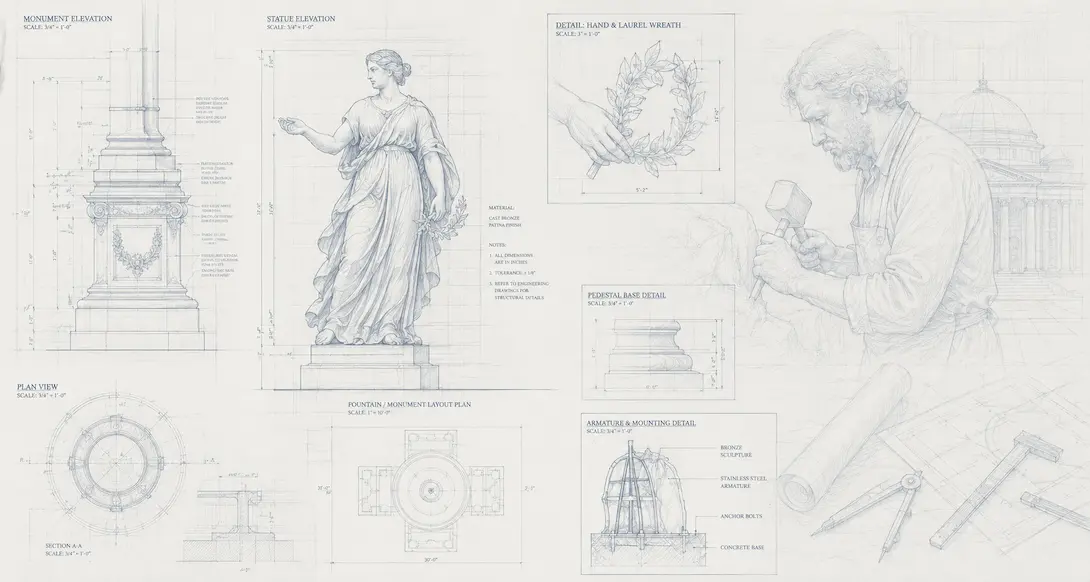
Confidence Is Built Before Production
Therefore, when handled properly, approvals reduce uncertainty, improve communication, and help prevent costly mistakes later in the project.
Ultimately, approvals and revisions are where confidence is built.
Why Custom Statue Approvals Matter
First, a custom statue is unlike many other purchases because the artwork does not yet exist.
Next, the project begins with an idea that gradually evolves into sketches, designs, models, and eventually a finished sculpture.
As a result, custom statue approvals create checkpoints throughout that journey and confirm that each stage remains aligned with the project goals.
Preventing Misunderstandings
For example, approvals allow stakeholders to review progress and confirm that the project remains aligned with its goals.
Otherwise, misunderstandings may go unnoticed until much later in the process.
By contrast, approvals allow concerns to be resolved before they become larger problems.
The Purpose of Custom Statue Revisions
At first, the word revision sometimes carries a negative connotation.
However, it should not.
Instead, custom statue revisions are a normal and healthy part of the creative process.
- Improve ideas
- Clarify expectations
- Strengthen communication
- Refine artistic direction
Refinement Creates Better Sculpture
In fact, the strongest sculptures rarely appear fully formed at the beginning.
Instead, they are refined through thoughtful discussion and careful review.
Therefore, revisions are often an important part of that refinement process.
When Custom Statue Approvals Begin
At first, many people think custom statue approvals occur only at the end of the design phase.
However, in practice, approvals often occur throughout the project.
- Project goals
- Subject selection
- Design concepts
- Symbolism
- Materials
- Scale
- Maquettes
- Production
- Installation
Each Approval Builds Clarity
As a result, every approval establishes confidence before moving to the next stage.
Therefore, rather than slowing the project, these checkpoints often prevent larger problems during manufacturing.
Approving Project Goals
First, one of the most important approvals occurs at the very beginning.
For example, stakeholders should agree on:
- Purpose
- Audience
- Location
- Long-term objectives
- Desired outcome
Agreement Prevents Confusion
In fact, many later challenges can be traced back to goals that were never clearly defined.
Consequently, agreement at the beginning often prevents confusion throughout the remainder of the commissioning process.
Design Approvals
Next, design approvals establish the artistic direction of the sculpture.
- Pose
- Composition
- Storytelling
- Symbolism
- Overall concept
Maquette Approvals
Similarly, three-dimensional review often becomes one of the most valuable approval stages.
- Proportions
- Visual balance
- Scale relationships
- Viewer experience
Material & Scale Approvals
In addition, approvals help confirm that selected materials, proportions, durability, maintenance expectations, and installation considerations remain aligned with project goals.
Final Custom Statue Production Approval
Finally, before manufacturing begins, custom statue approvals and revisions should confirm the design, likeness, symbolism, materials, scale, inscriptions, and presentation.
Therefore, this milestone matters because production represents a significant commitment of time, labor, and resources.
Why Timing Matters
Afterward, once molds are created, casting begins, or fabrication starts, major revisions become increasingly difficult.
As a result, production approval helps establish confidence before moving forward.
Who Typically Participates in Approvals?
In general, the approval process depends on the type of sculpture project being commissioned.
For example, some projects involve a single client, while others require collaboration among many stakeholders.
- Families
- Donors
- Universities
- Churches
- Municipal officials
- Veterans organizations
- Historical societies
- Community committees
Coordination Becomes More Important
Moreover, the larger the project, the more valuable organized communication becomes.
Therefore, clearly identifying decision-making authority helps projects move efficiently while avoiding conflicting feedback and unnecessary delays.
Public Monument Approval Process
In particular, public monument projects frequently involve the most extensive custom statue approval process because municipalities, committees, departments, and community stakeholders may all participate.
- Municipal governments
- Planning boards
- Public art committees
- Parks departments
- Historical commissions
- Community stakeholders
As a result, these reviews help ensure that public projects serve their intended audience while meeting local requirements.
For broader public-art context, project teams can review the U.S. General Services Administration Art in Architecture program and the Smithsonian American Art Museum’s Save Outdoor Sculpture! resource. These resources provide useful background on federally commissioned art and the documentation of public sculpture.
Religious & Memorial Approvals
Similarly, religious sculpture often includes review by church leadership, theological advisors, religious committees, and donors.
In addition, memorial projects frequently include careful review of:
- Facial likeness
- Pose
- Symbolism
- Inscriptions
- Presentation
Why Revisions Are Easier Early
Overall, one lesson becomes apparent across many sculpture projects.
In general, the earlier a revision occurs, the easier it tends to be.
By contrast, the same change can become significantly more complex after mold making or casting.
Common Revision Requests
- Adjusting facial features
- Refining posture
- Modifying symbolic elements
- Revising inscriptions
- Changing pedestal design
- Adjusting scale
- Clarifying historical details
Ultimately, most revisions are intended to strengthen communication and improve the final sculpture.
Common Approval Mistakes
- Rushing through reviews
- Too many decision-makers
- Delaying feedback
- Failing to document approvals
- Treating revisions as problems
A Common Observation
In fact, the strongest sculpture projects are rarely those with the fewest revisions.
Instead, they are usually the projects where revisions occurred at the appropriate stage of the process.
As a result, thoughtful feedback, timely approvals, and clear communication transform ideas into successful sculptures.
The Goal Is Not Fewer Revisions
Overall, the goal is to make the right revisions at the right time.
Therefore, approvals and revisions show that stakeholders are engaged and committed to creating the strongest possible sculpture before production begins.
Typical Custom Statue Approval Stages
| Approval Stage | Primary Focus |
|---|---|
|
Project Goals
|
Confirm the sculpture’s purpose, audience, location, stakeholders, long-term objectives, desired outcome, and overall definition of success. |
|
Design Review
|
Evaluate pose, composition, expression, storytelling, symbolism, artistic direction, and how effectively the concept supports the project goals. |
|
Maquette Review
|
Review proportions, visual balance, three-dimensional relationships, gesture, scale, presentation, and the viewer’s experience before enlargement. |
|
Material Approval
|
Confirm appearance, durability, production method, environmental performance, finish, maintenance expectations, and suitability for the installation. |
|
Scale Approval
|
Verify the relationship between sculpture, pedestal, site, architecture, viewing distance, audience, landscape, and surrounding environment. |
|
Production Approval
|
Authorize manufacturing after the design, details, likeness, symbolism, materials, scale, inscriptions, and presentation have been formally accepted. |
|
Installation Approval
|
Confirm foundations, engineering, anchoring, final placement, orientation, site readiness, access, safety requirements, and project completion details. |
From the Statues.com Team
Through decades of experience, our team has learned that approvals should never be viewed as delays. Instead, they are opportunities to build confidence before significant resources are committed.
Ultimately, the strongest sculpture projects result from thoughtful conversations, careful review, and timely decisions—not from the absence of revisions.
Successful Approvals Provide
- Clear expectations
- Stronger communication
- Better stakeholder alignment
- Reduced project risk
- More confident production
- Higher overall project quality
Frequently Asked Questions About Custom Statue Approvals and Revisions
Why are approvals important?
In general, custom statue approvals and revisions ensure that everyone involved agrees on the design, goals, and direction before production begins.
What types of approvals are common?
For example, projects commonly include approvals for goals, design, symbolism, scale, materials, maquettes, production, and installation.
Why are revisions normal?
As a result, custom statue revisions help refine ideas, improve communication, and strengthen the final sculpture before manufacturing begins.
Who approves a custom statue?
In addition, custom statue approvals may involve clients, families, donors, churches, universities, municipalities, veterans organizations, or community committees.
Why are maquette approvals valuable?
For example, maquettes allow stakeholders to evaluate the sculpture in three dimensions before committing to full-scale production.
Why do public monuments require more approvals?
Consequently, public projects often involve municipalities, planning boards, historical commissions, and community review processes.
Why do religious projects have additional review?
Similarly, religious sculptures often require evaluation of symbolism, tradition, theology, and spiritual appropriateness.
What happens after final approval?
Afterward, the project moves into manufacturing, including mold making, fabrication, casting, finishing, and installation preparation.
Why should revisions happen early?
Therefore, changes are typically easier, faster, and less costly before production begins.
What is the most important approval principle?
Ultimately, clarity is the most important approval principle. Successful approvals ensure that everyone shares the same understanding before significant production resources are committed.