
The Raised Fist: Solidarity, Black Power and a Symbol in Sculpture
A closer look at how the raised fist became a defining image of Black Power, why context matters, and what changes when a graphic gesture becomes a three-dimensional work of art.
The raised fist is a visual symbol whose meaning has shifted across movements and historical settings. In Black political culture, it became especially associated with Black Power in the late 1960s. Tommie Smith and John Carlos's black-gloved salute at the 1968 Mexico City Olympics became one of the era's most enduring images of protest and solidarity.
The Raised Fist Has More Than One History
The raised fist did not begin with one organization, one leader or one moment in the 1960s. The clenched-hand gesture has appeared in different political and labor traditions, and its meaning has changed with the people using it. That distinction matters: a powerful symbol can have a recognizable form without carrying exactly the same message in every setting.
Within U.S. Black political culture, however, the fist became especially visible as part of Black Power iconography in the late 1960s. Artists, activists and organizations used it to communicate solidarity, resistance and collective strength. This is a more accurate history than treating the Civil Rights Movement as a single point of origin.
1968: Tommie Smith, John Carlos and the Olympic Salute
One of the most widely recognized raised-fist images came from the men's 200-meter medal ceremony at the 1968 Summer Olympics in Mexico City. American athletes Tommie Smith and John Carlos lowered their heads and raised black-gloved fists during the U.S. national anthem. The image became inseparable from conversations about racism, inequality and Black Power.
The moment also demonstrates why visual symbols can outlast the event that first brought them to a mass audience. A gesture requiring no text could be photographed, reproduced and interpreted around the world. The Smithsonian's National Museum of African American History and Culture discusses the salute as a landmark image within the history of Black Power.
Read the Smithsonian's overview of the foundations of Black Power →
What Can a Raised Fist Communicate?
The meaning always depends on context, but four ideas recur when the raised fist appears in Black political and cultural imagery.
Standing Together
The closed hand can suggest people acting as a group rather than as isolated individuals.
Refusing Silence
Raised overhead, the gesture can communicate opposition, resolve and a refusal to disappear from public view.
Collective Purpose
The fist is often read as an active gesture, connecting visual identity with organizing and public demonstration.
A Recognizable Sign
Its simple silhouette makes it easy to reproduce across prints, posters, murals, clothing and sculpture.
From Black Power Iconography to American Art
The fist's cultural importance is visible not only in documentary photographs but also in fine art. Chicago artist Barbara Jones-Hogu, an original member of AfriCOBRA, incorporated Black Power imagery into bold prints centered on Black empowerment and affirmation. The Smithsonian American Art Museum identifies the raised fist in her work as a central salute of solidarity and connects her imagery to both artist Elizabeth Catlett and the 1968 Olympic salute.
This movement between protest, printmaking, murals and sculpture is important. It shows how a symbol can become part of visual culture while retaining historical associations. The artwork is not merely decoration; its form, setting and audience influence how the gesture is understood.
Explore Barbara Jones-Hogu at the Smithsonian American Art Museum →
What Changes When the Fist Becomes Three-Dimensional?
A graphic fist can be understood instantly from its silhouette. Sculpture adds mass, surface and viewpoint. The viewer can move around the knuckles, wrist and fingers; light changes across the form; the gesture occupies the same physical space as the person seeing it.
That makes proportion and finish especially important. Too much detail can weaken the clarity of the silhouette, while too little can make the hand feel generic. A successful raised-fist sculpture needs to remain recognizable from several angles and at the viewing distance for which it was designed.
The Statues.com Solidarity Fist Statue translates the gesture into a compact bonded-marble sculpture. The Statues.com Art Team created the original Solidarity Fist sculptures in 2020; the current shop piece measures approximately 6.5 inches high by 3 inches wide by 3.75 inches deep.
Explore Related Sculptures
For readers who want a physical sculpture connected to solidarity or Black history, these are direct links to current Statues.com shop pieces. Product availability and finishes may change; the product page is the source for current options.
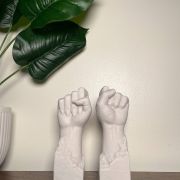
Solidarity Fist Statue
A compact bonded-marble interpretation of the raised-fist gesture, designed by the Statues.com Art Team.
View in Shop
Bessie Coleman Bust
A portrait sculpture honoring pioneering aviator Bessie Coleman, available in bonded-marble finish options.
View in Shop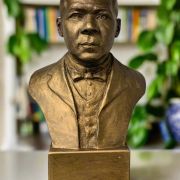
Booker T. Washington Bust
A sculptural portrait of educator and author Booker T. Washington, created for display in homes, schools and collections.
View in ShopA Symbol Is Not a Single Message
The raised fist has traveled across decades, countries and causes. That wide use is precisely why interpretation requires historical context. A fist in a 1968 Black Power print, a contemporary demonstration and a sculpture made for personal display may share a visual form without having identical meanings.
For museums, educators, collectors and readers, the useful question is not simply “What does this symbol mean?” but “Who is using it, when, where and for what purpose?” That approach preserves the specific history of Black Power while acknowledging the fist's broader visual life.
Frequently Asked Questions
What does the raised fist symbolize?
Its meaning depends on context. Common associations include solidarity, resistance, collective strength and political visibility. In Black political culture, the raised fist became strongly associated with Black Power during the late 1960s.
Did the raised fist originate in the Civil Rights Movement?
No single 1960s event can accurately be described as the origin of the raised fist. The gesture has appeared in multiple movements and traditions. Its visibility as Black Power iconography, however, grew dramatically in the late 1960s.
Why were Tommie Smith and John Carlos's raised fists significant?
Their black-gloved salute during the medal ceremony at the 1968 Mexico City Olympics created an internationally visible image of protest against racial inequality. The photograph became one of the enduring visual references of Black Power.
What is the Statues.com Solidarity Fist made from?
The current Statues.com shop listing describes the Solidarity Fist Statue as made from bonded marble and offered in multiple finishes. Check the product page for current availability and finish options.
Explore the Solidarity Fist Sculpture
See the current finish options and product details directly in the Statues.com shop.
View Solidarity Fist