
Statues.com Sculpture Buying Guide
Buying a Bust Statue: 9 Things to Consider
A practical guide to choosing the right subject, scale, material, finish and display location for a portrait bust that belongs in your space.
Statues.com / Knowledge Center / Bust Statues

Quick answer
Before buying a bust statue, confirm why you want it, where it will be displayed, the available dimensions, the appropriate material, the level of portrait accuracy, the quality of the sculpture and casting, the total delivered cost, and whether a ready-made or custom bust best fits your purpose.
A bust statue represents a person through the head, neck, shoulders and often part of the upper torso. Because the format concentrates attention on the face and expression, a portrait bust can communicate identity and character without requiring the space of a full-figure statue.
Busts are displayed in homes, offices, libraries, schools, universities, museums and civic buildings. Some buyers choose an existing sculpture of a historical figure. Others commission a portrait of a founder, family member, educator, public servant or person whose legacy deserves a permanent presence.
The best choice is not always the largest or most expensive. It is the sculpture whose scale, material, finish and meaning work together in the intended environment.
1. Begin with the purpose of the bust
Purpose determines nearly every decision that follows. A small historical bust for a bookshelf has different requirements from a commissioned portrait for a university lobby or memorial room.
Choose a subject and style that adds meaning to an existing collection.
Prioritize likeness, expression, inscription and an appropriate display location.
Coordinate scale, finish and pedestal height with the room.
Write one sentence describing what the sculpture should accomplish. If that sentence is unclear, the buying criteria will also remain unclear.
2. Choose between a ready-made bust and a custom portrait
A ready-made bust is the practical choice when the subject already exists in a collection and the available size and finish suit your space. It is normally faster to acquire and easier to compare before purchase.
A custom portrait bust is appropriate when the subject is a specific person, the likeness must be developed from photographs, or the sculpture requires a particular scale, clothing, expression, base or inscription. A custom project should include documented review stages before production. See the Statues.com concept-to-completion process for an overview of collaborative approvals.
3. Measure the display space before choosing the size
Product height alone does not tell you how a bust will feel in a room. Consider the sculpture together with its base, shelf, cabinet or pedestal. Check the total height, width and depth, then allow open space around the silhouette.
- For a shelf or bookcase, measure vertical clearance and shelf depth.
- For a desk or console, confirm that the base will sit securely without crowding other objects.
- For a pedestal, evaluate the combined eye level of the pedestal and bust.
- For a public interior, test visibility from the main approach and normal viewing distance.
- For a heavy sculpture, verify the load capacity of the furniture or support.
A useful method is to mark the proposed height and width with removable tape or place a cardboard silhouette in the location. This reveals proportion problems before you order.
4. Select a material that matches the environment
| Material | Visual character | Best suited for | Questions to ask |
|---|---|---|---|
| Bronze | Traditional, substantial and capable of detailed patina finishes | Permanent displays, memorials and significant commissions | Is it cast bronze? What patina and maintenance are recommended? |
| White bonded marble | Bright, smooth and classical in appearance | Indoor collections, offices, libraries and presentation pieces | Is it cast solid? Is a bronze-tone finish available? |
| Resin or composite | Versatile and generally lighter in weight | Decorative interiors, gifts and projects with weight limitations | How is the surface finished? Is it intended for indoor or outdoor use? |
| Natural stone | Unique veining and traditional carved presence | High-end interiors and permanent architectural settings | What stone is used? How should it be supported and maintained? |
Do not assume a bronze-colored surface means the sculpture is cast bronze. Product descriptions should identify the underlying material and the applied finish separately.
5. Evaluate craftsmanship and portrait quality
A strong bust is more than a recognizable face. The head, shoulders, neckline, clothing and base must form one coherent composition. When reviewing photographs or a physical sample, examine the work from several angles.
- Do the facial proportions feel balanced from the front and profile?
- Are the eyes, mouth and expression intentionally resolved?
- Does the transition from head to shoulders look natural?
- Are hair, clothing and surface textures handled consistently?
- Is the base level, stable and visually appropriate?
- Are mold seams, air pockets or unfinished areas visible?
For a custom portrait, ask how reference photographs are evaluated and when you will approve the likeness. A supplier should be able to explain the review process without relying on vague promises.
6. Decide on the finish and surrounding light
Finish changes how the same sculpture reads. White surfaces emphasize form through light and shadow. Bronze tones can create warmth and visual contrast. Traditional bronze patinas can range from brown and black to green or other controlled color treatments.
Look at the room's natural and artificial light. Strong overhead light can deepen eye sockets and cast dramatic shadows. Soft side lighting often reveals facial modeling more clearly. Avoid placing a highly reflective finish directly opposite a strong window if glare will obscure the portrait.
7. Compare the complete price, not only the product price
The complete cost may include the sculpture, finish selection, custom base, plaque or engraving, packaging, shipping, insurance, pedestal and installation. Custom portrait work also includes artistic development, approvals, mold making and production.
When comparing quotes, confirm that the sculptures use comparable materials, dimensions and services. A lower price is not useful if it excludes the base, secure packaging or the level of portrait development the project requires.
8. Plan shipping, handling and installation
Ask for the packed dimensions and weight, not only the sculpture dimensions. A small bust may ship as a parcel, while a large or fragile work may require a custom crate and freight delivery. Confirm who is responsible for insurance and what must be documented if damage is discovered.
For public, institutional or high-value installations, determine how the bust will be secured to its pedestal or display surface. The attachment method should protect both the sculpture and the surrounding property.
9. Review the seller's evidence and aftercare information
Look beyond promotional language. Review clear product specifications, original photographs, material descriptions, dimensions, production information and examples of completed work. For a custom commission, ask who develops the portrait, how approvals are documented, what changes are included and how the finished work will be delivered.
A responsible seller should also provide care guidance appropriate to the material and finish. Keep this information with the purchase record for future cleaning, relocation or conservation decisions.
A final checklist before buying
- I know the purpose and intended audience.
- I measured the complete display area.
- I confirmed the sculpture's material, finish and dimensions.
- I reviewed photographs from more than one angle.
- I understand the complete delivered cost.
- I confirmed shipping, insurance and damage procedures.
- I know how the sculpture should be displayed and maintained.
- For a custom bust, I understand the portrait approval process.
When these questions have clear answers, the purchase becomes a considered decision rather than a guess based on one product photograph.
Examples from the Statues.com shop
Compare bust sizes and subjects
These ready-made pieces illustrate different subjects, scales and collection uses. Product availability and current pricing are shown on each product page.
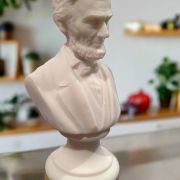
Abraham Lincoln Mini-Bust
A compact 6-inch bonded marble portrait available in white or a hand-applied bronze tone.
View product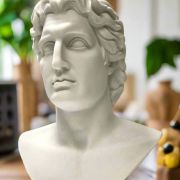
Alexander the Great Bust
A solid-cast, 10-inch white bonded marble bust with a classical historical subject.
View product
Frances Perkins Bust
An original Statues.com portrait offered in two compact sizes and two finish options.
View productQuestions buyers often ask
What is a good size for a bust statue?
The right size depends on viewing distance and furniture scale. Compact busts work well on shelves and desks. Larger portrait busts need more visual space and often benefit from a dedicated pedestal.
Which material is best for an indoor bust?
White bonded marble, bronze, resin and natural stone can all work indoors. Choose according to the desired appearance, weight, budget, durability and level of craftsmanship rather than selecting by material name alone.
Can a custom bust be created from photographs?
Yes. A sculptor can develop a three-dimensional portrait from photographs when the references clearly show facial structure from several angles. Image quality, consistency and documented approval stages are important.
What should I verify before ordering online?
Confirm the underlying material, finish, exact dimensions, weight, return or damage policy, shipping method and whether the photographs show the actual product design.
Does a bronze-tone finish mean the bust is bronze?
No. Bronze tone describes the color or surface treatment. The underlying sculpture may be bonded marble, resin or another material. Check the material specification separately.
Need a portrait bust created for a specific person?
Share the subject, reference photographs, intended size, material preference and display location with the Statues.com team.