
Little Ava: Creating a Sculpture of Hope for the Appalachian Valley Autism Center
The story behind a deeply personal portrait sculpture modeled after the first learner of the Appalachian Valley Autism Center — and how one child's image became a symbol of hope, achievement and possibility.
Some Commissions Begin With a Monument. This One Began With a Little Girl Named Ava.
Created for the Appalachian Valley Autism Center in Pikeville, Kentucky, “Little Ava” was modeled after Ava, the granddaughter of Pikeville Medical Center Chairman, President & CEO Donovan Blackburn. Ava was the first learner at the center that carries her name.
What began as a deeply personal family story became a sculpture intended to represent something much larger: hope, possibility, and the children and families served by the Appalachian Valley Autism Center.
The Story Behind the AVA Center
Pikeville Medical Center established the Appalachian Valley Autism Center to provide specialized therapy for children diagnosed with autism spectrum disorder.
The AVA Center provides multidisciplinary services including Applied Behavior Analysis therapy, speech therapy, occupational therapy, physical therapy and feeding therapy.
Its mission centers on identifying children early and providing individualized services designed to help each child reach their potential.
Behind the institution, however, is the story of Ava herself.
In a June 2, 2026 letter supporting Statues, Inc. and Victoria Karpos, Donovan Blackburn explained that the sculpture was modeled after his granddaughter Ava when she was four years old. He also identified her as the first learner of the AVA Center.
From a Child's Story to Sculpture
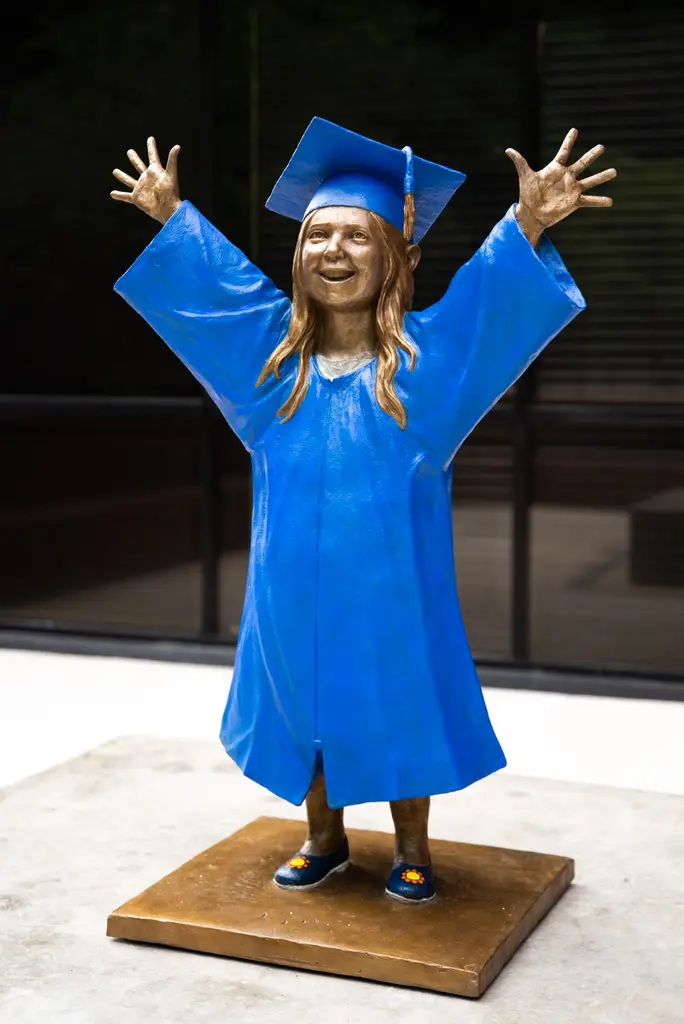
The finished sculpture depicts Ava in a graduation cap and gown, her arms raised high in celebration.
The pose communicates immediately.
There is movement, joy, accomplishment and optimism.
Rather than presenting Ava in a formal or static pose, the sculpture captures a moment that feels triumphant — an image of a child looking forward.
The vivid blue graduation gown creates a strong visual focal point, while the warmer treatment of the face, hands and hair emphasizes the portrait and expression.
The result is not simply a likeness of Ava. It communicates an idea.
A child can grow, achieve and move toward possibilities that may once have seemed distant.

A Sculpture Children Could Connect With
One of the most meaningful measures of a sculpture's success can come after installation.
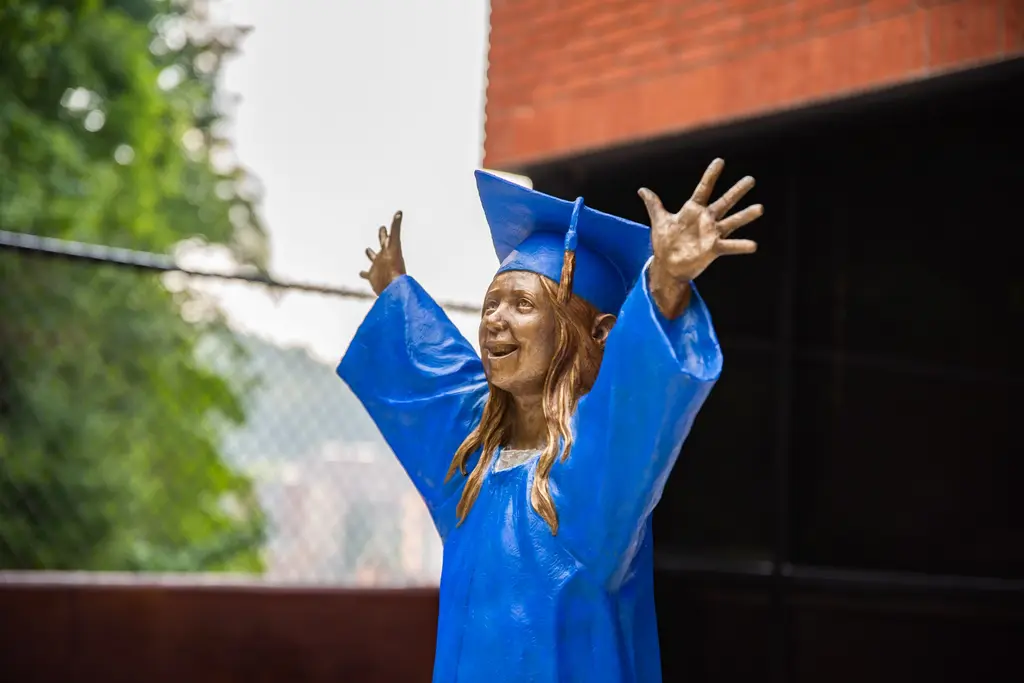
Statues.com's original project account describes the response surrounding the unveiling of Little Ava. Members of Blackburn's family had not known about the sculpture beforehand, while children at the center responded directly to the finished piece.
Children approached the sculpture, touched it and interacted with it.
Little Ava is not an abstract institutional symbol.
She is a recognizable child directly connected to the history and identity of the center.
A Beacon of Hope and Inspiration
Years later, Donovan Blackburn described the significance of the sculpture even more clearly.
That description may be the best measure of what this commission became.
Its significance goes beyond depicting the girl after whom the center was named.
It reflects what her story represents.
A joyful child in graduation clothing becomes an image of achievement, development and possibility.
The Importance of Understanding the Story Before Sculpting
Little Ava illustrates an important principle of custom portrait sculpture : a successful likeness alone is not enough.
Before sculpting begins, the creative team needs to understand why a person is being represented.
What should viewers feel?
What moment should be preserved?
What does the subject represent to the people who will encounter the finished work?
Those questions influence pose, expression, clothing, scale, finish and placement.
For Little Ava, a reserved portrait would have communicated a very different story.
The raised arms, graduation clothing and joyful expression turn the portrait into visual storytelling.
This is where commissioned sculpture becomes storytelling in three dimensions.
The objective is not merely to reproduce someone's appearance, but to communicate why their story matters.
Part of a Long-Standing Creative Partnership
The Little Ava project was not the first collaboration between Donovan Blackburn and Statues, Inc.
Blackburn's 2026 letter describes a relationship that began while he served as City Manager of Pikeville with the commission of the Mayor William C. Hambley Statue in downtown Pikeville's City Park.
He also identifies the Governor Paul E. Patton Statue at the entrance of the University of Pikeville as another significant project developed through the relationship.
Repeat commissions are meaningful evidence in significant portrait and public sculpture.
Returning clients already understand the artistic, collaborative and logistical demands involved in bringing an important sculpture from concept to completion.
Blackburn also emphasized the team's ability to understand the emotional importance behind each project.
From One Little Girl to a Regional Mission
The AVA Center continued to grow after its original Pikeville location opened.
Pikeville Medical Center later announced an additional AVA Center campus in Prestonsburg.
PMC has described the Pikeville facility as a four-story, approximately 27,000-square-foot center designed with autism-sensitive attention to features including texture, acoustics and lighting.
Regional reporting has subsequently documented continued growth in the number of children served by the program.
That development adds another layer of meaning to Little Ava.
The little girl represented by the sculpture became associated with a regional mission much larger than any one child or family.
When Sculpture Becomes Part of a Place
There is a difference between creating a statue and creating a sculpture that truly belongs somewhere.
Little Ava belongs at the AVA Center because the story of the sculpture and the story of the institution are inseparable.
Visitors do not need an art-history explanation to understand the raised arms and graduation gown.
They see celebration.
They see a child.
They see possibility.
For families arriving at a center dedicated to helping children develop and thrive, those ideas carry particular meaning.
Sculpture can give an abstract idea a physical presence.
Hope. Achievement. Courage. Memory. Possibility. Little Ava gives those ideas a place to stand.
A Relationship Built Across Multiple Pikeville Commissions
In June 2026, Donovan Blackburn provided a written recommendation describing Statues, Inc. and Victoria Karpos's team as a long-standing creative partner.
His letter identifies the Mayor William C. Hambley Statue, Governor Paul E. Patton Statue and Little Ava among the projects completed through that relationship.
View Original Client Letter“What sets Statues, Inc. apart is not just their technical mastery of bronze and marble, but their ability to understand the emotional weight behind each piece.”Donovan Blackburn Chairman, President & CEO
Pikeville Medical Center
Letter dated June 2, 2026
Lessons From the Little Ava Commission
The project illustrates several principles that matter when commissioning portrait, memorial and institutional sculpture.
Understand the Story First
Likeness matters, but understanding why a subject is being represented determines the emotional direction of the sculpture.
Pose Communicates Meaning
Ava's raised arms, graduation clothing and joyful expression communicate achievement before a viewer reads a single word.
Context Matters
The sculpture works because its subject, symbolism and location are directly connected to the mission of the AVA Center.
Accessibility Has Power
A sculpture that invites people to approach and interact can become part of the lived experience of a place.
Trust Builds Better Commissions
Long-term client relationships create shared understanding of the responsibility behind meaningful public sculpture.
Sculpture Can Embody an Idea
Strong commissioned sculpture can translate abstract concepts such as hope and achievement into physical form.
Project References
This case study combines Statues.com's project documentation, first-hand client evidence and information published by Pikeville Medical Center and independent regional media.
- First-Hand Client Documentation Donovan Blackburn — Letter of Recommendation for Statues, Inc., June 2, 2026 →
- Statues.com Project Archive Statues.com — Little Ava Statue / AVA Center Project →
- Primary Institution Pikeville Medical Center — Appalachian Valley Autism Center →
- Pikeville Medical Center AVA Center — Mission and Support →
- AVA Center Expansion Pikeville Medical Center — New AVA Center Prestonsburg Campus →
- Independent Regional Reporting WYMT — Pikeville Medical Center Celebrates Growth of AVA Center →
Have a Story Worth Preserving in Sculpture?
Tell us who or what you would like to honor. Our team can help you understand the artistic, material and production decisions involved in transforming that story into sculpture.