
Women in History Deserve to Be Seen
How sculpture can help broaden the visible record of history by giving influential women a permanent physical presence.
Journalist Maura Casey explored the long-standing imbalance in public monuments in her 2023 essay “Women in history deserve statues, too.” Her article discusses Victoria Karpos and Statues.com as part of the growing effort to increase the visibility of historical women through sculpture.
Read Maura Casey's Original ArticleThe People We Represent in Sculpture Become Part of the History We See
Public sculpture does more than decorate a city, campus, museum or government building. It tells future generations which lives, achievements and stories a society considered worthy of remembering.
For much of American history, the physical record presented through statues and monuments has been overwhelmingly male.
Presidents, military leaders, industrialists and statesmen have long occupied prominent places in parks, civic spaces and institutional collections.
Many women who shaped journalism, civil rights, literature, education, science and political reform have been far less visible in the sculptural landscape.
Journalist Maura Casey explored that imbalance in her March 2023 article “Women in history deserve statues, too.”
From the Capitol Basement to the Rotunda
Casey's story examines one of the most symbolic examples of the struggle for representation: the Portrait Monument honoring women's suffrage pioneers Elizabeth Cady Stanton, Susan B. Anthony and Lucretia Mott.
The monument was presented to the United States in 1921 following ratification of the 19th Amendment.
Yet for decades, it remained away from the prominent setting of the United States Capitol Rotunda.
It eventually returned to the Rotunda in 1997.
Who gets represented in sculpture, and whose stories remain absent?
That question extends well beyond a single monument. It reaches into museums, schools, libraries, universities, public spaces and the collections through which generations encounter history.
Victoria Karpos and a Different Approach at Statues.com
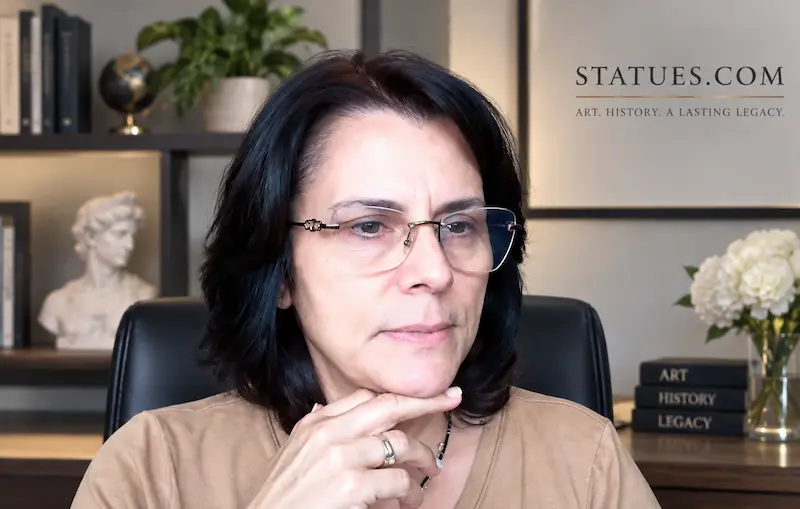
Helping broaden the representation of influential women through historical sculpture.
Casey's article also turns to Victoria Karpos and the work of Statues.com.
Victoria described recognizing an imbalance within the world of commercially available sculpture.
Mythological women were represented. Historical male figures were widely available. But real women who had changed history were far harder to find.
That observation helped encourage a deliberate effort to expand the representation of historical women through sculpture.
Giving Historical Women a Physical Presence
The historical figures discussed in Casey's article demonstrate just how broad that missing record can be.
Journalist, educator and civil rights advocate whose work challenged racial violence and injustice.
A major leader in the American women's rights movement and one of the central figures represented in the Portrait Monument.
A leading advocate for women's suffrage whose activism became inseparable from the history of voting rights in America.
Abolitionist, women's rights advocate and one of the three women represented in the Portrait Monument.
Suffrage leader and strategist whose work helped advance women's voting rights and later the Equal Rights Amendment.
Author, poet and civil rights figure whose work became an enduring part of American literature and culture.
Why Physical Representation Matters
A sculpture gives history a physical presence.
A student encountering a sculpture of Ida B. Wells may ask who she was.
Someone seeing Susan B. Anthony may want to understand what she fought for.
A young visitor encountering Maya Angelou represented in sculpture receives a subtle but important message:
Her life and accomplishments are worthy of remembrance.
Representation in sculpture does not merely preserve the past. It can influence which historical stories people discover in the future.
Sculpture Is Part of How We Write History
Monuments are sometimes treated simply as artwork.
They are more than that.
The people represented in bronze, marble, bonded marble, stone and other sculptural materials become part of a society's visible historical record.
What we choose to place in museums, libraries, universities, government buildings and public spaces communicates something about the stories we believe deserve to endure.
That makes representation in sculpture important.
The goal is not to diminish the historical figures who are already represented.
It is to broaden the visual record so that it more fully reflects the people who contributed to history.
Continuing the Conversation
For Statues.com, creating sculptures of historical women belongs within a much larger responsibility: preserving stories through three-dimensional art.
Some sculptures honor nationally recognized historical figures.
Others preserve the memory of educators, founders, community leaders, family members or people whose influence was deeply important within a particular institution or community.
The audience may differ, but the responsibility remains similar.
Maura Casey's article provides an important reminder that public memory is not fixed.
It changes as society looks again at history and asks whose contributions have been overlooked.
Sculpture has a unique role in that process because it transforms remembrance into something physical, visible and enduring.
Historical figures should not simply be recorded.
They should be seen.
What Representation Through Sculpture Can Accomplish
Sculpture influences how people encounter history in physical spaces and which stories become part of everyday public memory.
Makes History Visible
Sculpture gives historical people a physical presence that can spark recognition, curiosity and learning.
Broadens Public Memory
Expanding who is represented helps the sculptural record reflect a wider range of historical contributions.
Creates Educational Moments
A sculpture can become the starting point for discovering a person's achievements, struggles and historical context.
Gives Institutions a Voice
Museums, schools and public organizations can use sculpture to communicate the people and values they believe deserve recognition.
Connects Generations
A permanent sculpture allows future generations to encounter people whose lives shaped the world they inherited.
Preserves a Story
At its strongest, portrait sculpture translates a person's history and significance into an enduring three-dimensional form.
Read the Original Article
This Statues.com editorial was inspired by Maura Casey's independent discussion of women, monuments, public memory and the work of Victoria Karpos and Statues.com.
Women in History Deserve Statues, Too
The struggle to increase the visibility of women in America's monumental landscape, including discussion of Victoria Karpos, Statues.com and sculptures representing historical women.
Who Deserves to Be Remembered in Sculpture?
Whether you are planning a historical portrait, institutional tribute, public monument or custom commission, Statues.com can help you understand the artistic and production decisions involved in transforming a meaningful story into sculpture.