
Alaska Territorial Guard Memorial
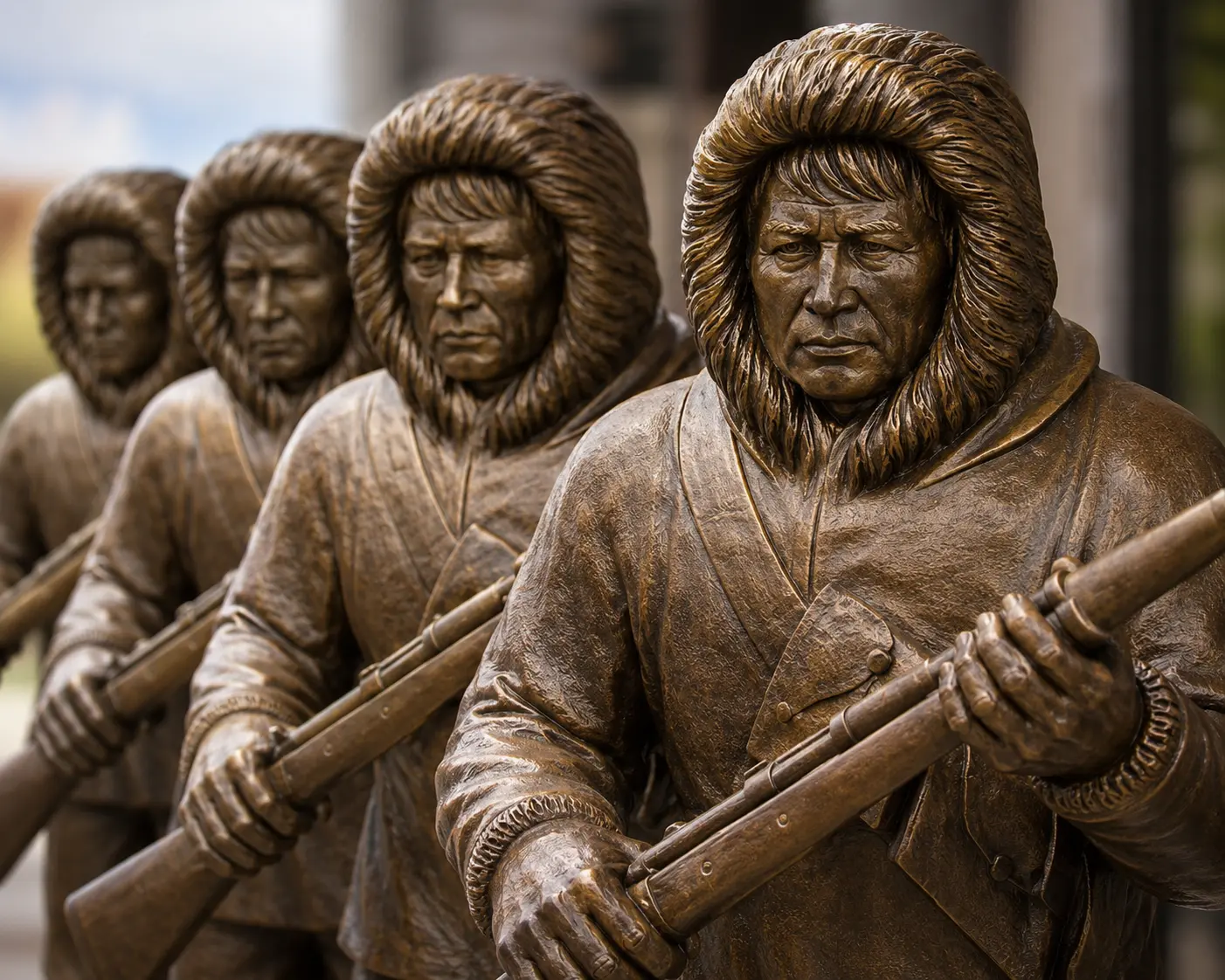
Eight life-size bronze statues created to honor the Alaska Native volunteers and other residents who defended Alaska during World War II.
A Memorial to Alaska’s World War II Defenders
The Alaska Territorial Guard Memorial gives permanent form to a story that went without broad public recognition for decades.
Created during World War II, the Alaska Territorial Guard served from 1942 to 1947. More than 6,300 Alaska Native volunteers from 107 communities joined the force, using their knowledge of Alaska’s terrain, weather and coastline to watch for enemy activity and help protect the territory.
The memorial project began in 2003 through the vision of the late Alaska Native artist James Grant and collaboration with the artisans at MarbleCast Statues, the Salt Lake City production studio associated with Statues.com. The result was a completed series of eight life-size bronze figures placed in Alaska to support statewide remembrance.
Eight cast-bronze editions transform the story of the Alaska Territorial Guard into durable public monuments that communities can encounter, study and remember.
Who Were the Alaska Territorial Guard?
The Alaska Territorial Guard was a volunteer military reserve organized after the Japanese occupation of islands in the Aleutian chain exposed the strategic vulnerability of Alaska.
Years of Service
The unit was organized during World War II and remained active until 1947.
Alaska Native Volunteers
Volunteers came from more than 100 communities across an immense and demanding region.
Coastline Watched
Guard members served as the military’s eyes and ears along Alaska’s coastline.
Guard members monitored coastal areas, reported suspicious ships and aircraft, protected key facilities and transportation routes, and supported the defense of Alaska. Their service depended on local knowledge, hunting and tracking skills, mobility in Arctic conditions, and a commitment to protect both ancestral homelands and the United States.
The unit is sometimes identified in historical records as the “Eskimo Scouts.” Modern writing generally uses the formal name Alaska Territorial Guard and identifies the distinct Alaska Native peoples and communities involved whenever reliable records allow.
From a Difficult Idea to a Statewide Memorial
A public memorial succeeds only when historical responsibility, artistic authorship and technical production remain aligned.
James Grant’s Artistic Direction
The late James Grant developed the figure as a dignified representation of an Alaska Territorial Guard member. The cold-weather clothing, period rifle, stance and expression communicate readiness, endurance and service without turning the memorial into an abstract symbol.
Statues.com Studio Production
The approved sculpture had to become a repeatable, full-scale bronze edition while retaining its character and surface detail. The Salt Lake City studio contributed the production knowledge needed to move the work through clay refinement, mold preparation, bronze fabrication, finishing and readiness for delivery.
How the Bronze Figures Were Produced
Creating multiple life-size memorial castings requires more than enlarging a model. Each stage must preserve the artist’s approved form while producing structurally sound bronze figures with consistent details and finishes.
Historical Reference and Sculptural Design
Clothing, equipment, pose, expression and scale are established from the approved concept and available historical references.
Full-Scale Clay Sculpting
The figure is modeled in clay over a supporting armature so anatomy, drapery, equipment and surface character can be refined before molding.
Mold Making and Wax Patterns
A production mold captures the approved sculpture. Wax sections reproduce the details needed for the lost-wax bronze casting process.
Bronze Casting and Assembly
Individual sections are cast, fitted, welded and chased so the seams disappear and the complete figure reads as one continuous sculpture.
Patina, Protection and Delivery
The finished bronze receives its patina and protective surface treatment before final inspection, packing, transportation and site installation.
For a detailed explanation of this workflow, visit the Bronze Statue Guide and the complete commissioning guide.

Why Bronze Was Chosen for the Memorial
Bronze is the benchmark material for permanent outdoor monuments because it combines strength, fine-detail reproduction, repairability and a long record of exterior performance. For a veterans memorial distributed across Alaska, the material also carries the visual weight and institutional permanence expected of civic commemorative sculpture.
- Captures facial features, clothing and equipment detail
- Suitable for permanent outdoor public settings
- Supports multiple castings from one approved mold
- Develops a dignified, historically familiar patina
- Can be professionally cleaned, waxed and conserved
- Provides strong long-term value for public monuments
What This Project Demonstrates
The Alaska Territorial Guard Memorial is not only a bronze sculpture project. It is a practical example of how public art can connect historical research, community purpose, artist-led design and repeatable monument production.
Begin With the Story
The subject, audience and reason for remembrance should guide every artistic and technical decision.
Represent People Accurately
Clothing, equipment, identity, naming and interpretive language require evidence and respectful review.
Design for Multiple Locations
A durable mold and controlled production standard allow one approved artwork to serve several communities.
Match Bronze to the Mission
Long-term public exposure and commemorative importance justified a permanent cast-metal solution.
Plan Beyond the Sculpture
Foundations, anchors, shipping routes, lifting access, plaques and maintenance all affect successful installation.
Protect the Memorial
Routine inspection, gentle cleaning and periodic conservation preserve both the patina and the public story.
Organizations considering a veterans memorial, historical figure or civic monument can use the Public Monument Planning Guide to evaluate committees, funding, approvals, site selection, engineering, fabrication, installation and long-term maintenance before production begins.
Related Statues.com Resources
Alaska Territorial Guard Memorial FAQ
The Alaska Territorial Guard was a volunteer military reserve organized in 1942 to help defend Alaska during World War II. More than 6,300 Alaska Native volunteers from 107 communities served, monitoring the coast and supporting territorial defense until the unit was disbanded in 1947.
The memorial figure was designed by the late Alaska Native artist James Grant. The project was developed through collaboration with the production artisans at MarbleCast Statues and Statues.com in Salt Lake City, Utah.
Statues.com’s project record identifies eight completed life-size bronze figures. The editions were created to extend recognition beyond a single site and support remembrance in communities across Alaska.
The figures were cast in bronze. Bronze preserves fine sculptural detail, performs well outdoors when properly maintained and has the permanence expected of a public military memorial.
The project involved production work by the MarbleCast Statues and Statues.com team in Salt Lake City, Utah, in collaboration with artist James Grant.
Once an approved sculpture and production mold exist, bronze editions can carry the same memorial story to several locations. This model gives more communities direct access to the artwork while maintaining consistent artistic and historical standards.
Yes. Statues.com develops custom military and veterans memorials from concept and historical reference through sculpting, mold making, casting, finishing, shipping and installation planning. Every project requires its own scope, approvals, site plan, budget and schedule.