
Memorial Sculpture Guide
Memorial Sculptures: Giving a Life, Story and Legacy Physical Form
A successful memorial does more than mark a name. It gives people a place to remember a person, understand a contribution and encounter that story in three dimensions.
What makes a memorial sculpture meaningful?
Memorial sculptures translate memory into a physical object. Some are realistic portraits. Others use a symbolic figure, relief, inscription or abstract form. The right approach depends on who or what is being remembered, who will encounter the work and where it will be installed.
This is why a memorial should begin with the story rather than the material. Before choosing bronze, bonded marble or another medium, identify the essential idea the sculpture must communicate. A strong concept can be understood before a visitor reads a plaque.
Recognizable identity
For a portrait memorial, facial structure, expression, age and posture help connect the sculpture to a specific person.
Details that carry meaning
Clothing, gestures, meaningful objects and inscriptions can communicate profession, service, belief or personal character.
A relationship with place
Scale, sightlines, pedestal height, landscape and visitor circulation influence how the memorial is experienced.
Portrait, symbolic or narrative memorial?
A portrait statue is appropriate when individual identity is central to the commission. Historical figures, community leaders, family members and people associated with a particular institution are often represented this way. When photographs are available, the sculptor can study facial proportions, clothing and other visual evidence while developing the three dimensional portrait.
Symbolic memorials work differently. A figure, gesture or object can express faith, service, sacrifice, learning or another idea without reproducing one person literally. Narrative memorials can combine portraiture with plaques, reliefs or secondary elements that give visitors more historical context.
None of these formats is automatically more meaningful than another. The design should follow the purpose of the memorial and the experience intended for its audience.
Planning a custom memorial sculpture
A memorial commission becomes easier to evaluate when the main decisions are made in a logical order.
Experience matters when memory is the subject
Memorial work asks the sculptor to balance artistic interpretation with responsibility to the people represented. Statues.com brings more than 30 years of sculpture experience and a portfolio of more than 1,000 projects to that process. The practical work includes reference evaluation, portrait development, client review, material selection, fabrication, shipping and installation planning.
For public memorials, the site introduces additional questions. The work must be legible at the intended viewing distance, durable for its environment and coordinated with the pedestal or surrounding space. A privately commissioned memorial may allow a more intimate scale and a different relationship between sculpture and viewer.
Related Sculpture in the Statues.com Shop
Symbolic sculpture for reflection and remembrance
These are existing works available in the Statues.com shop. They are not presented as custom memorial commissions. They are included because devotional and symbolic sculpture can be meaningful in personal spaces dedicated to reflection or remembrance.
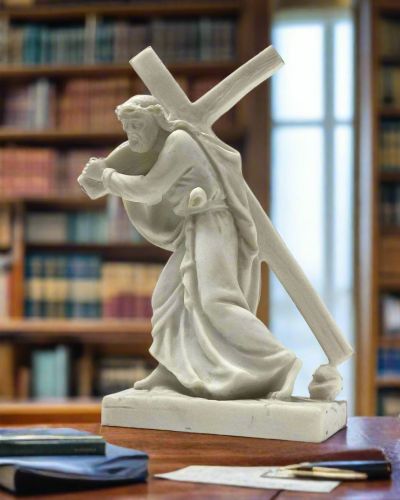 Christ Carrying the Cross Sacred sculpture centered on faith, sacrifice and reflection.
 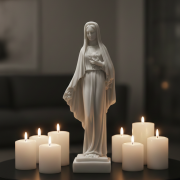 Immaculate Heart of Mary A devotional sculpture from the Sacred Sculpture Collection.
  Sacred Heart of Jesus Mini Bust A small devotional work intended for personal spaces and reflection.
 Product availability and options can change. The product pages above show current details.
Memorial Sculpture FAQ
What is a memorial sculpture?
A memorial sculpture is a three dimensional work created to commemorate a person, group, event or shared idea. It may use portraiture, symbolism, inscriptions or a combination of these elements.
Can a memorial statue be created from photographs?
Yes. Photographs can provide reference for portrait development, clothing and other details. Multiple clear views are preferable because the sculptor must interpret a three dimensional subject from two dimensional evidence.
What material is best for an outdoor memorial?
The choice depends on scale, location, desired appearance, budget and maintenance expectations. Bronze is widely used for permanent outdoor monuments. Other materials may be appropriate depending on the project and environment.
What should be decided before commissioning a memorial?
Start with the subject, story, intended site, approximate scale and available reference material. Those decisions give the sculptor a sound basis for discussing design, material, budget and production.
Planning a memorial sculpture?
Share the person or story you want to commemorate, the proposed location and any photographs or reference material you already have. The Statues.com team can help define the next practical steps.
Start Your Project View Our Work