
Colossus of Rhodes: History, Construction and the Truth Behind the Ancient Wonder
The giant statue of Helios stood for only a few decades, yet its scale, engineering and mythology made it one of the most famous monuments of the ancient world.
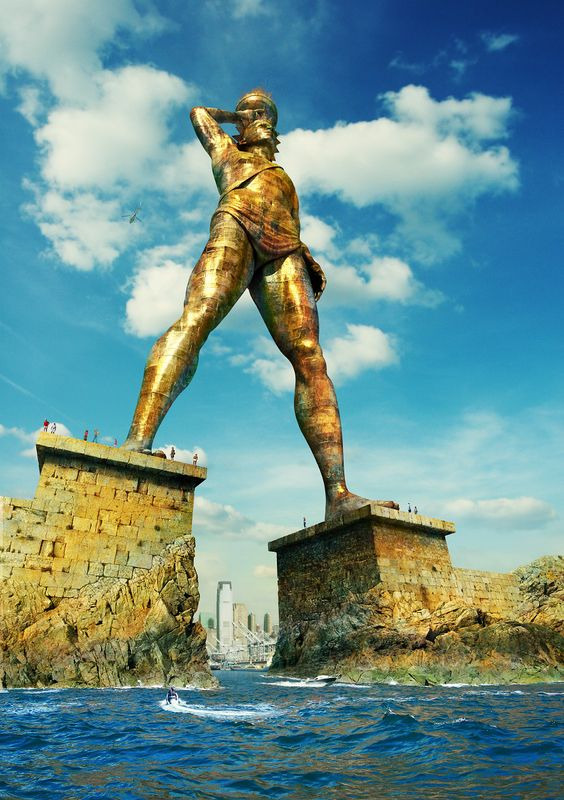
The Colossus of Rhodes was a colossal bronze statue of Helios, patron god of Rhodes, created by the Greek sculptor Chares of Lindos and completed around 280 BCE. Ancient sources place its height at about 70 cubits, roughly 33 meters (108–110 feet). It fell during an earthquake around 226 BCE and was never rebuilt.
What Was the Colossus of Rhodes?
The monument commonly called the “Statue of Rhodes” is better known as the Colossus of Rhodes, one of the Seven Wonders of the Ancient World. It represented Helios, the sun god closely associated with the island of Rhodes.
Its importance came from more than size. The Colossus combined religion, civic identity, military memory and advanced large-scale metalworking in a single public monument. Although it survived for little more than half a century, later writers continued to describe its extraordinary dimensions even after it had fallen.
A Monument Born From the Siege of Rhodes
The Colossus was commissioned after Rhodes successfully resisted the forces of Demetrius I Poliorcetes. Demetrius abandoned his siege in 304 BCE, leaving equipment behind. Ancient tradition connects the sale of abandoned siege material with the financing of a monumental dedication to Helios.
This corrects a common oversimplification: the monument was not simply built to celebrate a vague victory “over the ruler of Cyprus.” Its historical setting was the struggle surrounding the siege of Rhodes and the city's continued autonomy.
How Could an Ancient Statue Reach More Than 100 Feet?
Ancient accounts describe a structure using large quantities of bronze together with an internal system that included iron and stone. Chares of Lindos reportedly spent about 12 years completing the work. The exact construction sequence remains debated because the surviving descriptions were written well after the statue was built.
That uncertainty is important. Modern reconstructions can help us understand the engineering challenge, but they should not be confused with construction drawings from antiquity. What is reasonably secure is the extraordinary scale: Pliny the Elder gave a height of 70 cubits, commonly interpreted as roughly 33 meters.
For context on how bronze sculpture is produced today, see the Statues.com Bronze Statue Guide.
Did the Colossus Really Straddle the Harbor?
Probably not. The familiar image of a gigantic Helios standing with one foot on each side of the harbor entrance, ships sailing underneath, belongs largely to later artistic tradition. Surviving ancient sources do not establish that pose or even the monument's exact location.
The Popular Image
A towering figure spreads its legs across the entrance to the harbor while ships pass beneath it. Renaissance and later imagery helped make this version famous.
What the Evidence Supports
The Colossus was enormous and associated with Rhodes, but scholars do not know its precise pose or placement. Modern historians generally consider the harbor-straddling reconstruction implausible.
The same caution applies to details such as the exact position of the arms, whether the statue held an object, and precisely how Helios was clothed. Reconstructions should be labeled as interpretations rather than presented as documentary fact.
The Earthquake of 226 BCE
The Colossus did not stand for centuries. An earthquake around 226 BCE brought the monument down after approximately five decades. Ancient accounts describe the fallen remains as astonishing in their own right, emphasizing the immense scale of the broken fingers and limbs.
The statue was not rebuilt. Its ruined state became part of its story, and later generations inherited descriptions rather than an intact monument. That gap between surviving evidence and imagination helps explain why so many competing images of the Colossus exist today.
Why the Colossus Still Matters to Sculpture History
The Colossus demonstrates a recurring purpose of monumental sculpture: giving physical form to a community's identity, memory and aspirations. Its enormous scale turned a representation of Helios into a statement about Rhodes itself.
For modern sculptors and planners, its legacy also offers a useful lesson in separating evidence from reconstruction. Monumental works are understood through material, engineering, site, symbolism and the stories later generations tell about them. The Colossus remains famous precisely because all of those layers became intertwined.
Colossus of Rhodes: Frequently Asked Questions
How tall was the Colossus of Rhodes?
Ancient accounts give a height of about 70 cubits, commonly interpreted as approximately 33 meters, or 108–110 feet.
Who built the Colossus of Rhodes?
The monument is attributed to Chares of Lindos, a Greek sculptor from the island of Rhodes.
Was the Colossus of Rhodes made of bronze?
Ancient descriptions identify the Colossus as a bronze monument supported with internal structural materials including iron and stone. The exact construction method remains debated.
Did the Colossus stand across the harbor entrance?
There is no reliable ancient evidence that it stood with one foot on each side of the harbor. Modern historians generally regard that famous image as a later legend.
What happened to the Colossus of Rhodes?
An earthquake around 226 BCE caused the statue to collapse. It was not rebuilt, although its fallen remains continued to be described by ancient writers.
Separating the Monument From the Myth
Historical details in this article were cross-checked against modern summaries that discuss the ancient literary evidence and the uncertainty surrounding the Colossus's appearance and location.
National Geographic — Rise of the Colossus, One of the Seven Wonders of the Ancient World
World History Encyclopedia — The Seven Wonders
How Are Large-Scale Statues Commissioned Today?
Explore the modern planning process, from subject and scale to materials, approvals, fabrication and installation.
Read the Commissioning Guide